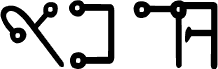
Passage du Fleuve by Daniel U. Thibault of Urhixidur Fonts is a free monoline dingbat font built from branching strokes and ringed nodes. Its symbols alternate sharp angles with long, elastic curves.
Experimental music posters and science-themed game interfaces can both use these diagram-like forms because they suggest notation as readily as circuitry. They also fit album packaging and event merchandise centered on electronic or avant-garde subjects. Repeated circles turn each mark into a small network or signal path and make the motifs part of the project's iconography.
A medieval (circa XIIth-XVth century) occult script derived from Hebrew. The French name means "Passing the River" and is probably an allusion to Deuteronomy, Chapter II, Verses 13-16, where Moses leads Israel across the river Zered into Canaan. With the Celestial and Malachim/Angelic/Royal scripts, it forms the Seraphic family of scripts. It is currently used by some Wiccan practitioners.
Passage du Fleuve is included by Heinrich Cornelius Agrippa in Book III (Ceremonial Magic), Chapter XXX («Another manner of making Characters, delivered by Cabalists») of his De Occulta Philosophia (written in 1509 and first printed in 1533), unfortunately without mentioning any details. Francis Barrett derived the alphabet from Agrippa, along with much of the text of Agrippa's book, and presented it in his «The Magus: A Complete System of Occult Philosophy», published in 1801.
Informações detalhadas do tipo de letra
Plataformas suportadas
PlataformaCodificação
UnicodeUnicode 1.0 semântica
MacintoshRomano
MicrosoftUnicode BMP só
Detalhes do tipo de letra
Criado2002-08-17
Revisão1
Número de glifos226
Unidades por em2048
Direitos de incorporaçãoIncorporação de edição permitida
Classe da famíliaSimbólica
EspessuraMédio (normal)
LarguraMédio (normal)
Estilo MacNegrito
DireçãoApenas glifos fortemente da esqueda para a direita + neutros